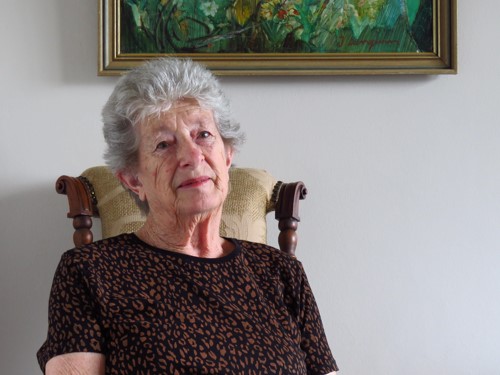
 “Playing cards is a bit like fishing. You never know what is going to come up.”
Living in Howick at Elizabeth Gardens (instead of way out of town on a farm) means that Linda Crooks can indulge her love of card playing many times a week. She acknowledges that few people want to drive all the way out on the dusty roads for a game of cards. The move happened five years ago when her husband, Fred, became very frail and caring for him was exhausting. He has since passed on.
Linda was born in Manchester, England, into a creative family. Linda often played card games like Happy Families during the long dark winters with her siblings, or on the trains to and from boarding school and holiday trips down to Devon. Her father was a journalist and broadcaster for BBC, and her mother, Grace, a painter, and illustrator. “They really shouldn’t have had children, but we all survived.” Aged 15, Linda’s mum whisked her off to Rhodesia and there was never any mention of school after that. Linda found employment in the arty circles her mother moved in, and particularly loved the uniform she wore for her job as an usher, showing people to their seats at the theatre. In Bulawayo, where there was a thriving art scene, she worked as a window dresser, at exhibitions, the opera and in film studios. After the war, young men from all over the world were posted in Rhodesia. Usually, they bought a motorbike with their first pay check and were keen on company for drives out in the country. “In those post-war days, the roads were just two strips of tarmac, if a car came, the bike had to stay on one strip, the car had to have two wheels on sand and two on the strip.” recalls Linda. There were dances to go to, swimming at the Bulawayo pool, “I was young, naïve and free, it was such fun” she remembers.
Travel was cheap on the boats and Linda occasionally went back to England to study or visit family. Although there were plenty of people playing bridge on the deck, Linda was not yet interested in cards. “I couldn’t see my way to living in England. It was so boring. It still is. If the bus is not on time, it’s a big deal.”
In the 50s they moved to Hillbrow in Johannesburg where her mother worked at the Art College. By then Linda had trained as a dress designer and pattern cutter and easily found work in the many small business designing clothes in the district. Fred Crooks attended evening classes run by her mother and ‘very conveniently’ offered to drive Grace home after class, in order to bump into lovely Linda.
After they married, Fred left his job as a scientist with CSIR and started designing and building houses on spec. Luckily, Linda loved gardening and with her creative eye made the spaces appealing and easy to sell. It did mean that there was a lot of packing up and moving around. They had four children, and Linda loved being a mother. After a few decades, Fred got bored with building and decided to go farming – first in timber and then in kiwi fruit (in an inappropriate climate). “I never met anyone like Fred. He did not wait around to see what life would do, he just made things happen himself. I am pleased that all my children are the same.” Well known Midlander, Nick Crooks, creator of The Old Mushroom Farm, is her son.
Nowadays, Linda plays bridge two or three times a week, much to her delight. “You have to adjust your idea about the possibilities of winning each round of cards because every deal is different. It makes for a certain brain agility. I find it invigorating, not knowing what your next deal will be. Other players might be strict about not chatting, but we don't have rules of that sort. We have loads of fun. All sorts of people play, but the problem with good card partners at our age is that they sometimes disappear!” she laughs.
When she hasn’t got a game on the go, Linda professes to do as little as possible – a few chores, fiddling around with plants, watching a wide range of news channels to understand what is important in different parts of the world. “It’s a funny thing about getting older. You know you should do all sorts of things, but you don’t.”
Author credit: Nikki Brighton